
It’s been five years since the last Canadian Census, which means Statistics Canada will soon be releasing updated insights into the country’s social and demographic landscape. And if current projections hold true, Canada’s diversity story continues to grow in both scale and depth.
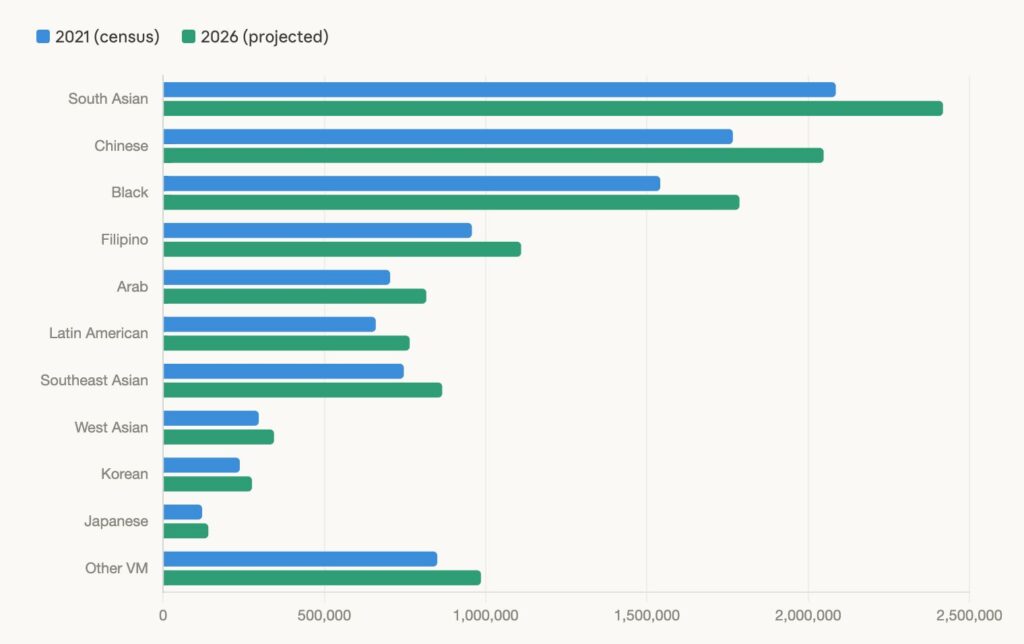
The chart below paints a vivid picture of how our visible minority population is expected to shift between the 2021 Census and 2026. The largest growth is projected among South Asian, Chinese, and Black communities, underscoring how immigration and intergenerational change continue to shape our cities and workplaces. Additionally, Filipino, Arab, and Southeast Asian populations are also expected to rise steadily.
While these macro-level projections are vital for long-term planning, there is a strategic gap that brands must navigate between these five-year snapshots. Large organizations frequently use Statistics Canada as the “gold standard” to weight and validate their internal research, but data is inherently a lag indicator – it confirms where we have been. To remain relevant, brands can supplement this foundational logic with real-time community listening. This allows for an understanding of the lived experiences that shift month-to-month, such as the evolving influence of Gen Z or changing economic household priorities that official data might not capture for years.
What’s important to note here isn’t just the numbers, it’s what they represent. Behind each data point are evolving cultural narratives, new generations, and new languages in our schools and communities that bring creativity and global perspective to every sector of society. For organizations focused on diversity, equity, inclusion, and belonging, these shifts emphasize the growing importance of culturally resonant engagement and authentic representation.
In practice, this means developing intersectional agility. Rather than viewing these projected populations as static “target markets,” brands can look at how age, disability, and language overlap within these groups to create more precise and respectful representation. By filling the gaps between Census years with human-centric curiosity, we ensure that our “diversity story” is not just about counting people, but about making people count.
As 2026 Census updates roll out, I believe it’ll be an important anchor to help policymakers, educators, and marketers alike create and implement plans that truly benefit the diverse mosaic of modern Canada.
Learn more about what we do and who we do it for on our services page.
Sign up for our newsletter here for more insights on marketing, advertising, communications, and how the industry intersects with inclusion.