
There’s a fascinating psychological phenomenon called the “essentialism bias” where humans unconsciously believe that categories have some underlying essence that makes them what they are. We see it everywhere – in how we sort people into neat boxes, assign fixed traits to groups, and convince ourselves that complexity can be reduced to simple labels.
Marketing has been living in this essentialist trap for decades. We’ve built entire strategies around the idea that you can understand someone by knowing their gender, ethnicity, or ability. The industry calls this “diversity marketing” or “multicultural marketing,” and we’ve been patting ourselves on the back for it since the 1990s.
But here’s what many – even seasoned – marketers do not understand; “diversity” or “multicultural” marketing misunderstands how humans live. It treats identity like a filing system – Black goes in this box, disabled consumers in that one, 2SLGBTQIA+ over there. The problem? Real people don’t fit in boxes.
And herein lies the main difference between the more popular terms like “Diversity Marketing” or “Multicultural marketing”, and the more nuanced “Inclusive Marketing”.
The primary missing piece from all this is intersectionality.
Intersectionality considers how various forms of oppression overlap and interact to create unique experiences. Rather than looking at lived experiences as standard, separable or generalizable sum of parts, it looks at whole human experiences. Take a look at this image below:
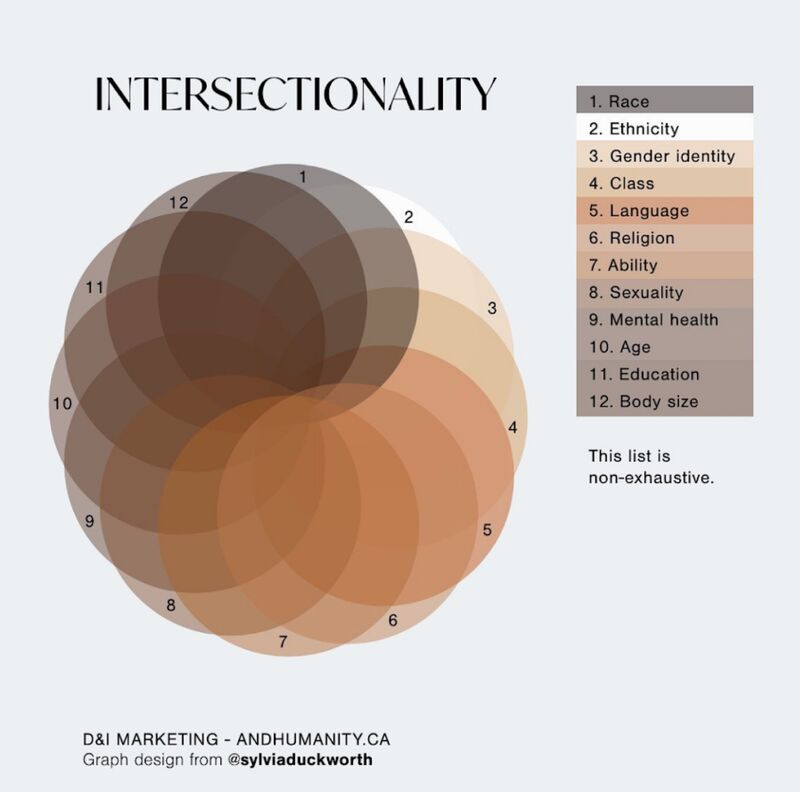
Why we love this diagram is that it illustrates how identities like race, ethnicity, class, language, religion, sexuality, mental health, education, and body size don’t exist in isolation – they overlap in endless, dynamic combinations that shape singular, whole human experiences.
With all this said, it should be clear that “diversity marketing” or “multicultural marketing” approaches are now outdated liabilities in 2026 – they breed tokenism, stereotypes, and missed connections while consumers demand authenticity. Retirement of these terms isn’t optional anymore; it’s survival. It’s time marketers look at their audiences as whole humans instead of categories, so they can start delivering campaigns that actually resonate deeply, drive loyalty, and reflect our intersectional reality. Like any big change, this shift will be difficult for the industry – but it all starts with one simple truth: nobody’s identity fits a box.
Learn more about what we do and who we do it for on our services page.
Sign up for our newsletter here for more insights on marketing, advertising, communications, and how the industry intersects with inclusion.